Why choose HDPE for heavy-duty chemical skincare products? The answer often starts with the container’s daily workload: concentrated formulas, repeated handling, and long storage. High-density polyethylene is lightweight, tough, and widely used for bottles and jerry cans. It can help resist impacts on a busy filling line or a crowded stockroom shelf. It also suits many creams, cleansers, and other personal-care products. But no plastic is automatically compatible with every formula.
Polymer specialist John W. McKeen’s materials-selection work supports a practical takeaway: “Choose a material for the conditions it must withstand, not appearance alone.” This is a paraphrase, not a verbatim quotation. That distinction matters. For a real package, teams should assess the exact formula, fragrance oils, surfactants, closure, and storage conditions. Check for leakage, deformation, odor transfer, and changes in product quality. Test filled packs over time, not just empty samples. Small details count. A cap can fail before the bottle does.
The seven benefits explored here include durability, low weight, chemical resistance, moisture protection, processability, recyclability, and cost efficiency. Each benefit has limits. Chemical resistance depends on the specific ingredients and exposure conditions. A thick HDPE bottle may feel reassuring, yet still need careful testing with an aggressive formulation. Good packaging decisions come from evidence, not assumptions. That is the useful starting point.
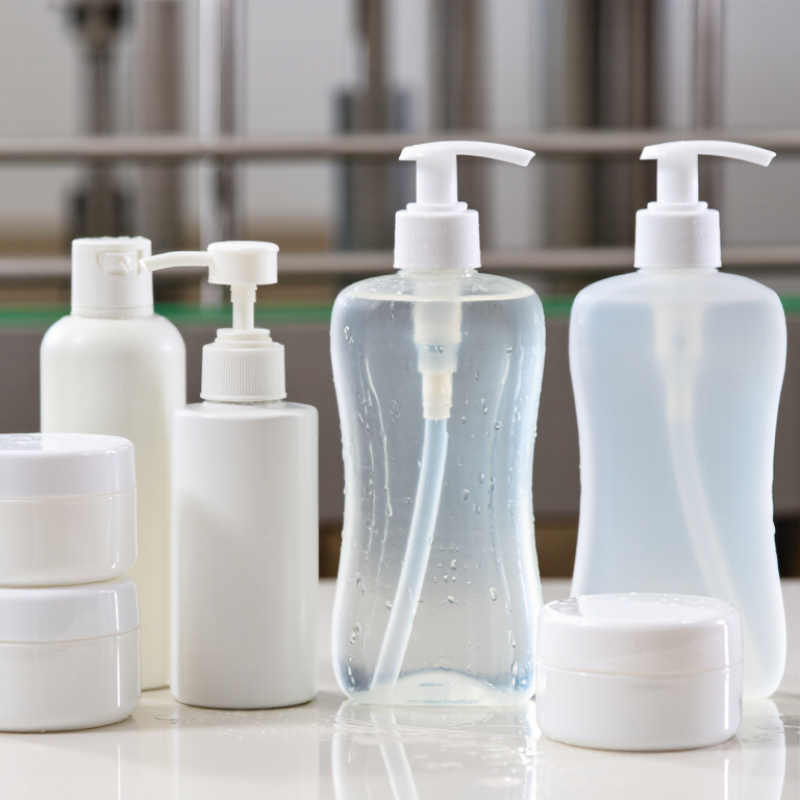
HDPE Basics for Heavy-Duty Chemical Skincare Packaging
HDPE basics matter when skincare formulas contain surfactants, acids, or concentrated salts. High-density polyethylene is a lightweight, semi-crystalline plastic with good impact resistance and generally low moisture absorption. It also resists many water-based chemicals. But compatibility is not universal: oils, solvents, heat, and long storage can cause swelling, permeation, or stress cracking. A bottle may look unchanged and still need testing.
PlasticsEurope’s Plastics – the Fast Facts 2023 reports that HDPE and MDPE made up about 12% of global plastics production in 2022. That scale reflects broad industrial use, not proof that every resin suits every formula. For heavy-duty packaging, test the actual product in its intended bottle, closure, and liner. ASTM D543-21 describes practices for evaluating plastic resistance to chemical reagents. Check for leaks, paneling, odor transfer, discoloration, and changes in cap fit over time. Small details count.
Wall thickness and bottle shape affect handling, too. A ribbed shoulder can help a container resist denting, while a secure closure limits spills during transport. Still, thicker walls add material and do not automatically prevent chemical permeation. There is a trade-off. I would treat compatibility results as formula-specific, then repeat checks under realistic storage conditions. Temperature swings matter. So does time.
7 Best HDPE Benefits for Heavy-Duty Chemical Skincare Packaging
HDPE is widely used for packaging because it combines chemical resistance, toughness, and practical manufacturability. The chart shows typical property ranges; units differ, so bar lengths are not directly comparable. Actual performance depends on the resin grade, package design, and test conditions.
Why HDPE is a strong packaging choice
- Chemical resistance: Often suitable for many acids, alkalis, and aqueous formulations; compatibility must be checked for each formula and storage condition.
- Impact toughness: Helps containers withstand handling and transport.
- Moisture resistance: HDPE absorbs very little water.
- Lightweight construction: Its relatively low density supports lighter packaging.
- Durable performance: Toughness and stiffness help packages retain their shape in use.
- Manufacturing versatility: Can be processed into common packaging formats such as bottles and closures.
- Recyclability: HDPE is identified as resin identification code 2; local collection and recycling availability varies.
Property values are indicative ranges reported for HDPE and vary by grade and test method. Confirm chemical compatibility and packaging suitability with testing under intended use conditions.
Chemical Resistance and Compatibility with Skincare Formulas
HDPE is often chosen for skincare containers because it tolerates many water-based and mildly acidic formulas. A cleanser can sit inside the bottle for months without the package softening or losing its shape. That matters in a busy bathroom, where bottles may be squeezed, dropped, or exposed to warm water. Its chemical resistance can also help protect the formula from contact with the container wall.
But compatibility is not automatic. Fragrance oils, concentrated surfactants, alcohol, and some active ingredients may behave differently depending on their concentration and the package design. A formula can cause swelling, stress cracking, odor transfer, or changes in appearance over time. Not every formula. Test the actual product in its intended bottle, with its closure and liner, under realistic storage conditions. Check samples at room temperature and after heat exposure, then inspect for leaks, discoloration, or changes in feel. Small trial batches are useful. They are not a substitute for longer storage checks. One overlooked detail is squeeze force: a thick lotion may need repeated pressure, which can stress the bottle near its shoulder. That is easy to miss during a quick compatibility review.
Durability, Impact Protection, and Leak Prevention
Heavy-duty skincare containers face more than shelf wear. They may encounter cleansing acids, surfactants, oils, and repeated handling. HDPE’s tough, semi-flexible structure can absorb knocks better than brittle packaging, reducing the chance of cracks when a filled bottle slips onto a hard floor. ASTM D4976 provides a specification framework for polyethylene grades; HDPE commonly has a density of about 0.941–0.965 g/cm³. Density alone does not guarantee performance, though. Resin grade, wall thickness, and molding quality all matter.
For leak prevention, look closely at the bottle shoulder, neck finish, cap liner, and seal. A sturdy body cannot compensate for a poorly matched closure. Chemical resistance also depends on the exact formula, concentration, temperature, and contact time. ASTM D543 outlines methods for evaluating plastics after chemical exposure, making it a useful reference for package testing. One detail is easy to overlook: oils or active ingredients may cause stress cracking in some combinations, even when the bottle looks sound at first.
Tip: Test filled samples, not empty bottles. Store them upright and on their sides, then check for softening, cracks, odor changes, and seepage. Add drop tests with the intended cap and closure torque. Small trials can reveal weak seams before production, though they cannot replace testing across real storage conditions.
7 Best HDPE Benefits for Heavy Duty Chemical Skincare? - Durability, Impact Protection, and Leak Prevention
| Benefit |
Relevant HDPE Property |
Value for Skincare Packaging |
Practical Consideration |
| 1. Strong chemical resistance |
HDPE resists many aqueous solutions, acids, alkalis, and salts. |
Can be suitable for many cleansers, lotions, and other formulations when the specific contents are compatible. |
Compatibility depends on the full formula, concentration, temperature, and storage time; test the filled package. |
| 2. Impact protection |
Its toughness and ductility help it withstand everyday knocks better than many brittle materials. |
Helps reduce the chance of a container cracking during handling, transport, or use. |
Impact performance varies with wall thickness, container shape, temperature, and resin grade. |
| 3. Durable construction |
HDPE is a robust thermoplastic commonly used for rigid bottles and containers. |
Supports packaging designed for repeated handling and heavier-duty applications. |
Durability is a package-level property; closures, seams, and manufacturing quality also matter. |
| 4. Potential for secure leak prevention |
A properly formed HDPE container can provide a continuous, non-porous wall. |
Helps contain liquids when the bottle, closure, liner, and dispensing system are correctly matched. |
Leak resistance cannot be assumed from the resin alone; verify closure fit and conduct package leak testing. |
| 5. Low moisture absorption |
HDPE absorbs little water compared with many materials. |
Can help the package retain its shape and properties in humid storage conditions. |
Low water absorption does not make every HDPE package a complete barrier to water vapor or gases. |
| 6. Lightweight and shatter-resistant |
HDPE containers can be made with relatively low mass and are less prone to shattering than glass. |
Can make products easier to handle and reduce breakage-related mess during ordinary use. |
Lightweight design must still meet the package’s strength, transport, and dispensing requirements. |
| 7. Recyclability where collection systems accept it |
HDPE is commonly identified by resin identification code 2. |
May be recyclable through programs that collect and process HDPE packaging. |
Acceptance varies by location; pumps, labels, pigments, residues, and package design can affect sorting and recycling. |
Note: Select packaging only after evaluating the specific skincare formula and testing the complete container-and-closure system under intended storage and transport conditions.
Moisture Resistance, Hygiene, and Product Shelf Life
HDPE’s moisture resistance helps keep water-sensitive skincare formulas stable during storage and daily use. Technical property data in the CAMPUS plastics database place water absorption for many HDPE grades at roughly 0.01–0.04% by mass, depending on grade and test conditions. ASTM D570 and ISO 62 provide standard methods for measuring this property. Low absorption can help limit container swelling and reduce moisture exchange through the bottle wall. Small benefit. A sound cap and liner still matter: moisture can escape through a poor seal.
HDPE’s smooth, non-porous surface is also practical for hygiene. It is easier to rinse and clean than rough or absorbent packaging, though clean packaging alone cannot preserve a contaminated formula. For heavy-duty chemical skincare, compatibility testing should reflect the actual formula, temperature, storage time, and repeated dispensing. Oils, fragrances, and concentrated surfactants may interact differently with different grades. That caveat matters. The FDA’s cosmetic manufacturing guidance emphasizes preventing contamination and maintaining suitable packaging and handling practices; it does not make any single resin a shelf-life guarantee. Use stability and package-compatibility studies to confirm performance, including checks for leakage, odor transfer, discoloration, and changes in product texture. One limitation: a sturdy bottle can protect the formula from handling damage, but it cannot correct an unstable formulation.
Design Flexibility, Cost Efficiency, and Environmental Considerations
7 Best HDPE Benefits for Heavy Duty Chemical Skincare?
Design Flexibility, Cost Efficiency, and Environmental Considerations
HDPE suits skincare containers that need sturdy walls and practical shapes. Blow molding can create rounded bottles, narrow-neck formats, and easy-grip sides. Adjusting wall thickness may reduce material use, though over-thinning can weaken drop performance. HDPE can also support efficient, high-volume production; actual savings depend on mold costs, order size, and transport. It is not a one-size-fits-all choice. Test the actual formula: oils, fragrance ingredients, and temperature can affect packaging performance.
Tips: Fill sample containers with the intended formula. Check for leaks, paneling, cap fit, and changes after storage.
Environmental Considerations
Environmental claims need care. The OECD’s Global Plastics Outlook (2022) estimated that only 9% of plastic waste worldwide was recycled in 2019. That figure covers all plastics, not HDPE alone. HDPE containers are accepted by many recycling programs, but local collection and sorting determine what happens next. Keep labels and closures compatible with the recycling stream, and avoid dark pigments where they hinder sorting. The details are easy to overlook.
Conclusion
Why choose HDPE for heavy-duty chemical skincare products? High-density polyethylene (HDPE) is a practical packaging material for skincare formulas that need sturdy, dependable containers. Its resistance to moisture and compatibility with many common ingredients can help protect product quality, while suitable packaging should always be matched to the specific formula. HDPE’s toughness also helps containers withstand everyday handling, reducing the risk of dents, cracks, and leaks when paired with a well-designed closure.
HDPE packaging can support hygienic storage and help limit exposure to external moisture, contributing to product shelf life when the container is properly designed and used. It is also adaptable to different shapes, sizes, and dispensing styles, making it easier to balance usability with production costs. Environmental considerations matter too: choosing the right container size, avoiding unnecessary packaging, and checking local recycling options can help guide responsible packaging decisions. Together, these qualities make HDPE a versatile option for demanding skincare packaging needs.

 Vikas Plastic